The Academy’s sea-woman demonstration
The Moon and the SunThe Academy’s sea-woman demonstration is a public test of what natural philosophy can establish about the Sea People—and a confrontation over who has the right to present that evidence. Yves de la Croix addresses the King’s scholars while concealing a crucial discovery, but Marie-Josèphe turns the demonstration toward the Sea Woman’s ability to breathe underwater. By locking herself inside the fountain cage and refusing to make the captive perform on command, she makes the limits of scholarly authority visible alongside the limits of the scholars’ knowledge.
Background and Evidence
Marie-Josèphe’s intervention rests on close examination rather than belief in marvels. In an earlier conversation, she corrected the assumption that she studied alchemy: Yves studied natural philosophy, she explained, while her own studies included a little mathematics. Later, in the laboratory, she examined the Sea Monster’s organs, preserved in spirits in heavy glass jars. The anomalous lobe looked ordinary to the naked eye, but its firmer, denser tissue differed markedly under the microscope. Rather than finding the shining organ of immortality imagined by alchemical speculation, she observed delicate overlapping leaves where ordinary lung tissue would have air sacs. She drew what she saw, making observation and description the basis of her claim.
That investigative history gives the public scene its central irony. The assembled scholars have come to hear Yves discuss the body, and his presentation appears to make the creature legible as a natural specimen. Yet he does not disclose the most distinctive anatomical result of his own work. The difference between what Marie-Josèphe has observed and what Yves chooses to say is not a disagreement about whether evidence matters; it is a contest over which evidence enters the official account.
The Public Demonstration
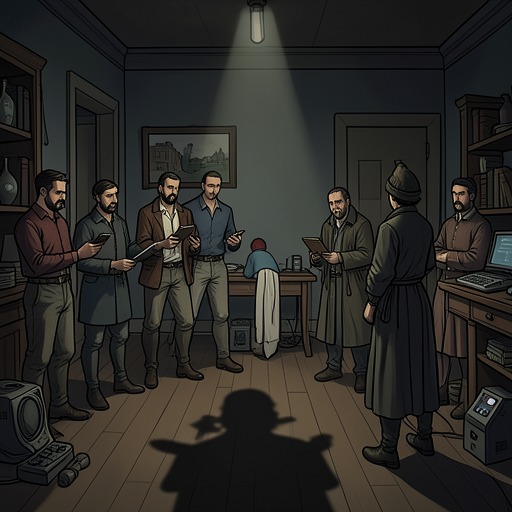
Footmen ceremoniously position the King’s portrait before Yves enters the tent with six scholars and their students. The visitors bow to the portrait and to Lucien de Barenton, Count de Chrétien, then gather around the dissection table; Lucien’s groom brings him a step-stool. Yves uncovers the body of the Sea Woman’s dead friend and speaks expansively in Latin, presenting the Sea People as natural creatures, albeit ugly ones, comparable to dugongs and sea-cows. He dissects an arm for the scholars, exposing its sinews, bones, and joints. Marie-Josèphe records the work, now able to recognize the dead man’s human features.
Asked about the creature’s physiology, Yves says that the Sea People have large lungs like slower sea mammals and that he has observed one remain underwater for ten or twelve minutes. He moves on to the heart without mentioning the anomalous lung lobe. He also describes the female as an imperfect copy of the male and suggests that little knowledge can be gained from her. The omission and the dismissal work together: his account presents the male body as the proper source of knowledge while leaving out the feature that would explain the living female’s capacity.
The Locked Gate
Yves orders Marie-Josèphe to call the Sea Monster for the scholars. She hurries ahead, locks the cage door, puts the key in her pocket, and sits with her hands folded. When Yves demands that she open the gate, she answers him in Latin that she cannot. As the scholars peer into the murky water, she identifies what they are witnessing: the Sea Woman is displaying her ability to breathe underwater. The senior scholar treats the claim as a mistake, and the others chuckle at the idea that Yves’s assistant has been addled by studying the classics.
Marie-Josèphe answers their dismissal with the anatomical finding Yves omitted: the Sea Woman’s lungs possess an anomalous lobe unique to the Sea People. She explains that the woman has not surfaced since the scholars arrived and that the lobe allows her to breathe from the water. Yves stiffens at the disclosure, but when a scholar asks whether the lobe exists, he admits that it does. He defends his silence by saying that he has not fully studied it and does not wish to pass on erroneous conclusions; the scholar praises this restraint. The exchange exposes the unequal treatment of uncertainty: Yves’s withholding is accepted as scholarly caution, while Marie-Josèphe’s knowledge is first mocked because she is his young female assistant.
The visitors ask to see the Sea Monster while she is alive. Yves takes up a pike and thrusts it through the bars, but the Sea Woman floats out of reach. Lucien then courteously asks Marie-Josèphe to open the gate. She refuses him too, apologizing while explaining that she would not resist his direction in any ordinary matter, but that this is a question of the Sea Woman’s life or death. When Lucien asks whether she is dying, Marie-Josèphe answers that she is saving her life and will wake at her King’s command. Her refusal is not simply disobedience: the locked gate prevents the gathering from converting a claim about underwater breathing into a forced spectacle.
Consequences and Significance
The Sea Woman sustains the demonstration by remaining submerged, but the scene gives her stillness a purpose beyond what the scholars can see. In the dirty pool, beneath bright sunlight and amid the voices of the men on land, she maintains her languor because Marie-Josèphe asked her to. She periodically gasps water into her lungs and expels it gradually. The supposed passive specimen is therefore participating in the encounter, while the human observers mistake restraint for an opportunity to demand more.
The episode brings experimental evidence, public authority, and captivity into direct collision. A dissected body, a microscope, a drawing, and a measured observation of time underwater all contribute to knowledge, but none alone determines how that knowledge will be used. Yves’s public standing allows him to frame the account and omit a result; Marie-Josèphe’s independent observation allows her to challenge that frame; and the Sea Woman’s submerged endurance makes the ethical cost of the demonstration impossible to separate from its scientific claim. The gate and its key become the practical boundary between exhibition and protection: Marie-Josèphe uses them to insist that the Sea Woman’s life cannot be subordinated to the scholars’ desire for a glimpse.